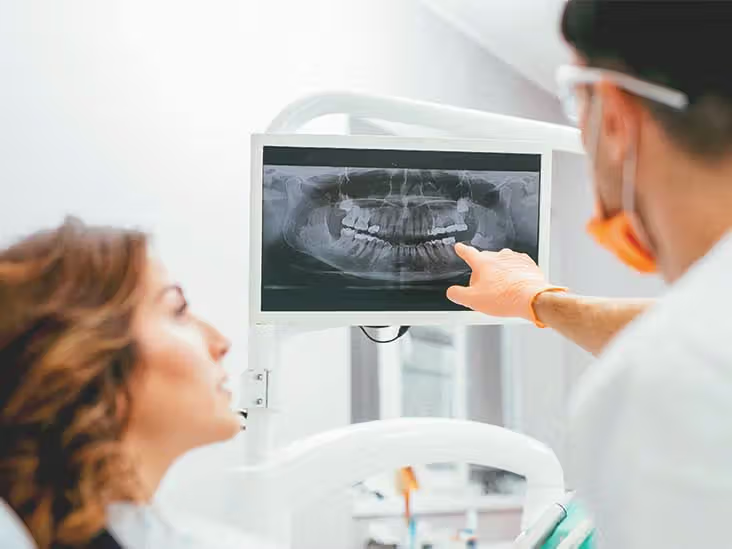
One of the most common things patients say after a dental appointment is some version of this: “But it does not hurt, so how can there be a problem?” It is a completely understandable reaction. We tend to associate dental issues with pain, sensitivity, or visible changes in our mouth. The reality is that many of the most significant things a dentist in Downtown Vancouver looks for on an X-ray are completely silent in their early stages. By the time a problem starts causing symptoms you can actually feel, it has often been developing for months or even years. This is precisely why X-rays are not just a routine formality. They are one of the most important diagnostic tools available in modern dentistry.
Decay Between the Teeth
Cavities that form on the biting surfaces of teeth are sometimes visible to the naked eye during a clinical examination. But decay that develops between two teeth, in the tight contact areas where one tooth meets the next, is almost impossible to see or feel until it has grown significantly.
These interproximal cavities, as they are called clinically, are one of the most common findings on dental X-rays in patients who have no pain, no sensitivity, and no idea that anything is happening. On an X-ray, early interproximal decay appears as a subtle shadow in the enamel layer. At this stage, it is small, manageable, and straightforward to treat. Left undetected, that same cavity can progress through the enamel into the dentine layer beneath, and eventually reach the pulp of the tooth, at which point a much more involved treatment is required.
Finding decay between the teeth on an X-ray before it becomes symptomatic is one of the clearest examples of why early detection genuinely makes a difference to both the complexity and cost of treatment.
Bone Loss From Gum Disease
Periodontal disease is a condition that progresses silently in many patients for a long time before noticeable symptoms appear. Bleeding gums during brushing is often the first sign patients become aware of, but significant bone loss can occur well before that point is reached.
Dental X-rays allow a dentist to assess the level of the bone surrounding each tooth and identify areas where bone height has reduced compared to what is expected. This bone loss is a direct consequence of the chronic inflammation associated with gum disease. It is not visible in the mouth and cannot be felt by the patient, but it is clearly visible on a radiograph.
Identifying bone loss early means that appropriate treatment, whether that involves more thorough cleaning, referral to a periodontist, or changes to home care, can be started before further bone is lost. Bone that has already been lost does not regenerate easily, which is why catching this early matters.
Infections at the Root Tip
A tooth that has a long-standing infection at its root tip, known as a periapical abscess or periapical lesion, will often show up clearly on an X-ray as a dark shadow around the end of the root. What surprises many patients is that these infections can be completely asymptomatic for extended periods.
A tooth may have had a root canal treatment years earlier and appear entirely normal to the patient. Over time, if bacteria have recolonized the root canal system, an infection can develop at the root tip without producing significant pain or swelling. Left unaddressed, these infections can grow, affect surrounding teeth and bone, and eventually become much more difficult to treat.
Routine X-rays allow your dental team to monitor previously treated teeth and identify any changes around the root tip before they become larger problems.
Cysts and Abnormal Tissue Changes
Cysts can develop in the jawbone around the roots of teeth, around impacted or unerupted teeth, or in areas of the jaw that appear completely normal from the outside. They grow slowly and rarely produce symptoms in their early stages. On an X-ray, they typically appear as a well-defined dark area within the bone.
Early detection of a jaw cyst allows for timely referral and management before the cyst has had the opportunity to expand and compromise the surrounding bone or neighbouring teeth. Some cysts, if left undetected for years, can reach a size that makes treatment considerably more involved than it would have been at an earlier stage.
X-rays can also reveal other changes in the bone or tissue that warrant further investigation, which may include referral for additional imaging or specialist assessment.
Impacted or Abnormally Positioned Teeth
Not every tooth erupts fully or in the correct position. Wisdom teeth are the most commonly impacted teeth, but other teeth can also fail to erupt properly or develop in positions that affect neighbouring structures. A tooth that is impacted and sitting within the jawbone will feel like nothing to the patient, but on an X-ray, its position, angle, and proximity to adjacent roots and nerves are clearly visible.
Monitoring the position of unerupted or impacted teeth over time allows your dental team to make timely recommendations about whether intervention is needed and, if so, when the most appropriate time to act would be.
Calculus Beneath the Gumline
Calculus, the hardened mineralized form of plaque, can accumulate below the gumline in areas that are impossible to see during a visual examination and impossible to feel from the outside. Subgingival calculus, as it is called, is a significant driver of gum disease and bone loss when left in place. On a dental X-ray, it can appear as a bright, dense deposit along the root surface, signalling areas where a deeper clean may be needed.
Changes in Existing Dental Work
Existing restorations such as fillings and crowns are visible on X-rays, and so are changes that occur around them over time. Decay that develops at the margin of an existing filling, often called secondary or recurrent decay, is a common finding that produces no symptoms early on but is clearly visible radiographically. Catching these marginal changes early means a restoration can be repaired or replaced before the underlying tooth structure is significantly compromised.
How Often Should You Have Dental X-Rays
The frequency of X-rays is not the same for every patient. It depends on your individual risk factors, your dental history, your age, and what has been found in previous examinations. Patients with a history of frequent cavities, active gum disease, or complex dental work may need more regular radiographic monitoring than patients with consistently healthy mouths and low-risk profiles.
Your dental team will recommend an X-ray schedule that is appropriate for your specific situation rather than a one-size-fits-all approach.
Book Your Appointment at Aria Dental Studio in Downtown Vancouver
At Aria Dental Studio, we use dental X-rays as part of a thorough and personalized approach to your care. If you have not had a full set of X-rays recently, or if it has been a while since your last comprehensive examination, we would be glad to help you get a complete picture of what is happening with your oral health. Call us at (604) 568-8686.
Book your appointment with our team in Downtown Vancouver.